
Introduction 💨 complete ebook
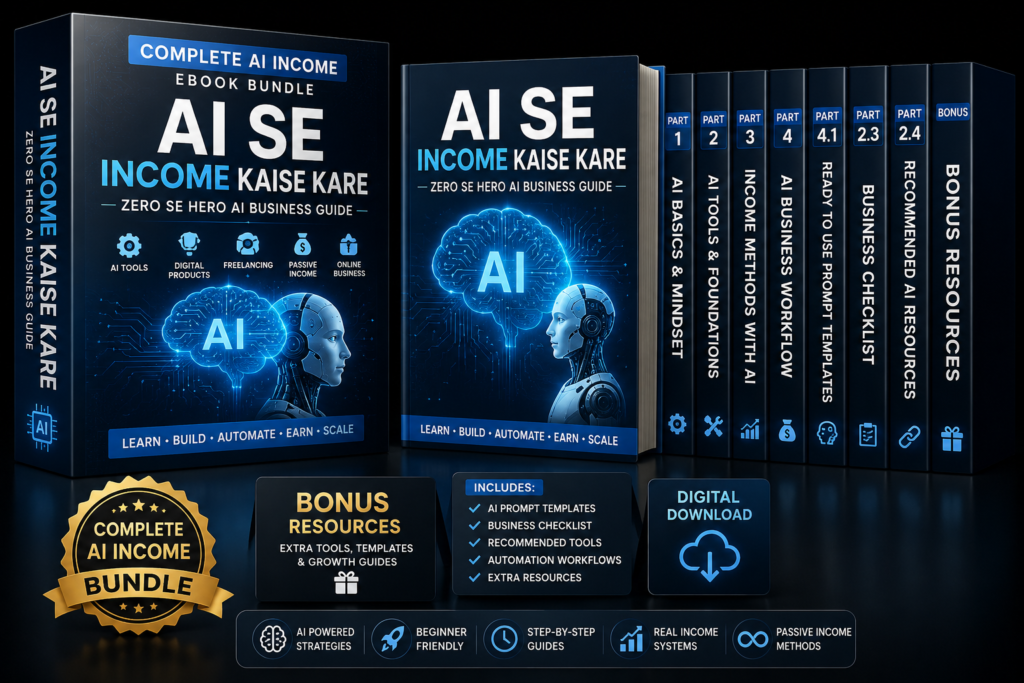
link: the ultimate AI online business blueprint link(click here)
Artificial Intelligence (AI) is one of the most transformative technologies of the 21st century. From unlocking smartphones with facial recognition to receiving personalized movie recommendations, AI has become a part of everyday life. Businesses use AI to automate tasks, improve customer experiences, analyze large amounts of data, and develop innovative products. Individuals use AI to write content, create artwork, learn new skills, organize their work, and even start online businesses.
In simple terms, Artificial Intelligence refers to computer systems that are designed to perform tasks that normally require human intelligence. These tasks include understanding language, recognizing images, making decisions, solving problems, learning from data, and generating creative content.
AI does not think or feel like a human being. Instead, it identifies patterns in data and uses those patterns to provide predictions, recommendations, or generated outputs. The more high-quality data and training an AI system receives, the better it usually performs.
What Does Artificial Intelligence Mean?😉
Artificial Intelligence is a branch of computer science focused on creating machines and software capable of performing tasks that traditionally require human intelligence.
Some examples include:
Answering questions in natural language.
Translating text between languages.
Recognizing faces in photographs.
Detecting spam emails.
Recommending products based on shopping habits.
Driving autonomous vehicles.
Generating realistic images and videos.
Writing articles, emails, and computer code.
These abilities allow AI to assist people in countless industries, making work faster, more efficient, and often more creative.
A Simple Example
Imagine you ask an experienced chef to prepare a new recipe. The chef uses years of experience, knowledge of ingredients, and cooking techniques to create a delicious meal.
Similarly, an AI model has been trained on vast amounts of information. When you ask it a question or give it an instruction, it uses patterns learned during training to generate the most relevant response.
While AI can produce impressive results, it does not “understand” information in the same way humans do. It predicts useful outputs based on its training rather than possessing consciousness or emotions.
A Brief History of AI😎
The concept of intelligent machines has existed for decades, but major progress has occurred only in recent years due to advances in computing power, large datasets, and machine learning.
1950s
Researchers began exploring whether machines could imitate human intelligence.
1960s–1980s
Early AI programs were developed to solve mathematical problems and perform simple reasoning tasks.
1990s–2010s
Machine learning became increasingly important, allowing computers to improve performance using data rather than relying only on manually written rules.
Today
Modern AI systems can generate text, create images, compose music, write software, analyze data, assist in research, and support millions of users across education, healthcare, finance, marketing, and entertainment.
Types of Artificial Intelligence
Although AI is often discussed as a single technology, it can be categorized into different types.
1. Narrow AI
Narrow AI is designed to perform specific tasks.
Examples include:
Voice assistants
Recommendation systems
Spam filters
Navigation apps
Chatbots
Most AI applications available today belong to this category.
2. General AI (Future Concept)
General AI refers to a hypothetical system capable of performing any intellectual task that a human can do.
Such systems do not currently exist and remain an active area of research.
3. Super AI (Theoretical)
Super AI describes a future scenario in which AI surpasses human intelligence in every field.
This concept is widely discussed in science fiction and academic research but does not exist today.
How AI Works
Most modern AI systems follow a simple process:
Step 1 – Collect Data
AI learns from large amounts of information such as books, articles, images, videos, and structured datasets.
Step 2 – Train the Model
Algorithms analyze patterns within the data, enabling the AI to recognize relationships and make predictions.
Step 3 – Generate Results
When a user provides an input (called a prompt), the AI uses its learned patterns to generate an appropriate response.
Step 4 – Improve Over Time
Developers refine AI models using testing, feedback, and updated training methods to improve accuracy and usefulness.
Where Is AI Used?
Artificial Intelligence is already integrated into many aspects of daily life.
Education
Personalized learning
Homework assistance
Language learning
Research support
Healthcare
Medical image analysis
Disease prediction
Administrative automation
Drug discovery
Business
Customer service chatbots
Marketing automation
Sales forecasting
Document generation
Finance
Fraud detection
Risk assessment
Investment analysis
Customer support
Entertainment
Music recommendations
Video recommendations
Game development
Image generation
Content Creation
Blog writing
Script generation
Video editing
Graphic design
Social media content
Benefits of Artificial Intelligence
AI offers many advantages when used responsibly.
Saves Time
Tasks that once required hours can often be completed in minutes.
Improves Productivity
AI can automate repetitive work, allowing people to focus on higher-value activities.
Enhances Creativity
It helps generate ideas, outlines, designs, and drafts that users can refine further.
Supports Learning
AI can explain complex topics, answer questions, and provide examples tailored to different skill levels.
Assists Businesses
Companies use AI to improve customer service, reduce costs, and make better decisions using data.
Limitations of AI
Despite its capabilities, AI is not perfect.
Some limitations include:
It may occasionally produce inaccurate information.
It does not possess human emotions or personal experiences.
It depends on the quality of its training and user instructions.
It should not replace professional advice in fields such as medicine, law, or finance.
Human review remains essential for important decisions.
Understanding these limitations helps users apply AI more effectively and responsibly.
Common Myths About AI
Myth 1: AI Knows Everything
Reality: AI can make mistakes and should be used with critical thinking.
Myth 2: AI Will Replace Every Job
Reality: AI is more likely to change many jobs by automating routine tasks while creating new opportunities for people with AI-related skills.
Myth 3: AI Is Only for Programmers
Reality: Modern AI tools are designed for everyone, including students, teachers, creators, freelancers, entrepreneurs, and business owners.
Myth 4: AI Is Difficult to Learn
Reality: Many AI applications require no programming knowledge and can be learned through regular practice.
Why Learning AI Matters
Artificial Intelligence is becoming an essential skill across nearly every profession. People who understand how to use AI effectively can often work faster, solve problems more efficiently, and create higher-quality results.
Whether your goal is to earn money online, grow a business, improve your studies, or increase productivity, learning AI can provide a significant advantage.
The key is not to compete with AI—but to learn how to work alongside it.
Chapter Summary
In this chapter, you learned:
What Artificial Intelligence is.
How AI works at a basic level.
The different types of AI.
Common real-world applications.
The benefits and limitations of AI.
Misconceptions about AI.
Why AI is an important skill for the future.
In the next chapter, we will explore ChatGPT, one of the world’s most widely used AI assistants, and learn how it helps users write, create, learn, solve problems, and build successful online businesses.
to read my full E-book please click this pdf link or wait till next blog of new chapter
link: https://drive.google.com/file/d/146t7G0ulUMkDltGF1a_Qaw-XBmsoSSrU/view?usp=drivesdk